萌学园
Air France-KLM tells GT their ban on portable air conditioners as baggage at Shanghai airport 'out of operation, safety reasons'_我的网站

A |
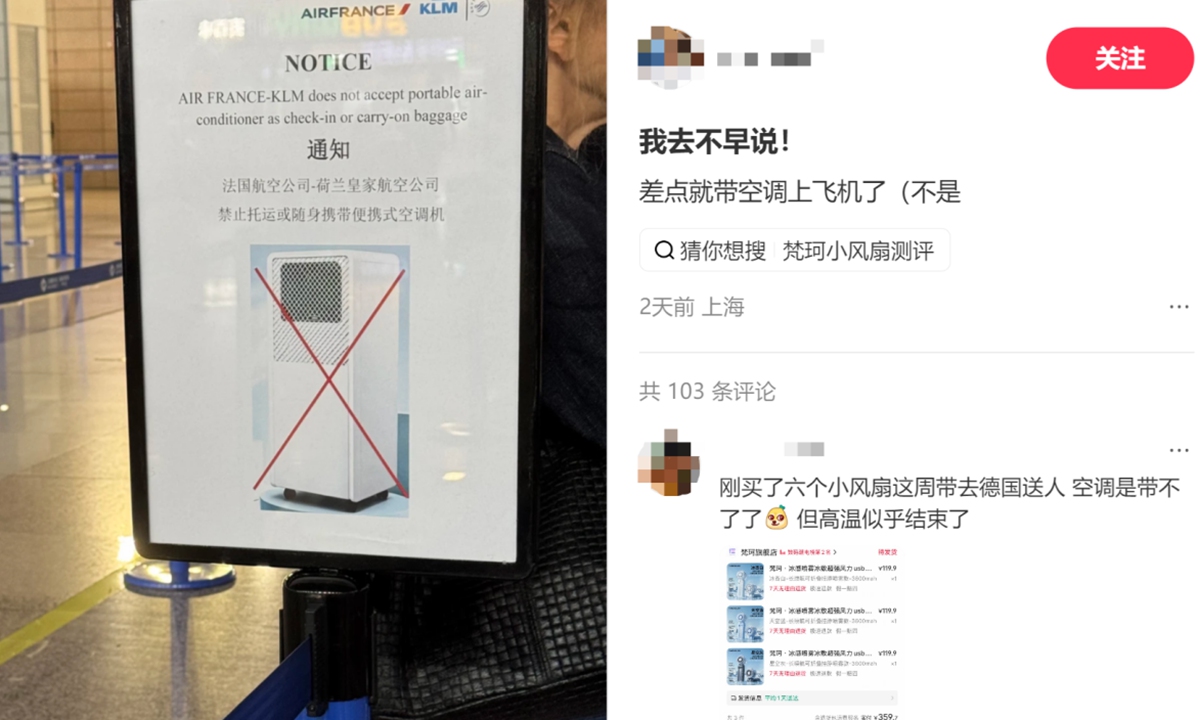
A notice at a check point at Shanghai Pudong International Airport that says "Air France-KLM does not accept portable air-conditioners as checked or carry-on baggage. Photo: Screenshot from website
A Rednote post recently sparked discussion and jokes among netizens after showing a notice stating that "Air France-KLM does not accept portable air conditioners as checked or carry-on baggage," against the backdrop of extreme heatwaves in Europe this summer and the difficulty of securing one in European markets.
Air France-KLM customer service later confirmed to the Global Times on Monday that the restriction was in place, explaining that passengers' baggage must comply with relevant rules and requirements, which are established based on operational and safety considerations.
The discussion came as Europe has been hit by persistent extreme heat in recent months, triggered widespread heat alerts and a surge in local demand for air conditioners, a product that was not widely installed in European households.
After the RedNote post was released, some netizens shared similar experiences in the comments section, with one writing: "I just bought six small fans to take to Germany as gifts, [now that] Air conditioners are out of the question. But it seems the heatwave is finally over."
Some speculated that the sign was put up after travelers to Europe tried to imitate a widely reported case in which a Chinese employee based in Shanghai helped a French colleague visiting China on a business trip bring an air conditioner from China back to Europe by air in July.
The story was shared by the Chinese employee on RedNote. After researching different models, the Chinese selected a compact unit suitable for international transport based on its size and weight. The air conditioner reportedly used non-flammable R410A refrigerant, with a refrigerant charge of 350 grams, and contained no lithium battery. According to the post, the netizen concluded that the unit could be transported as regular baggage transport rather than being treated as dangerous goods.
The netizen also carefully consulted the ICAO technical instructions and IATA dangerous goods regulations to determine whether the air conditioner needed to be handled as dangerous goods, per the post.
The French colleague, with sufficient baggage allowance, only paid for additional packing services. The total cost came to 1,412 yuan ($209.26), including 1,260 yuan for the air conditioner, 130 yuan for airport packaging, and 22 yuan for a high-power European power adapter.
The French passenger was reportedly transported the air conditioner successfully and arrived in Barcelona.
However, airlines have reminded passengers that while some air conditioners may qualify for checked baggage, strict requirements still apply.
Battery and refrigerant restrictions must be followed, as portable air conditioners containing lithium batteries are strictly prohibited from being checked in. Meanwhile, size and weight limits must be considered as the equipment must comply with airline baggage allowances, which typically limit individual pieces to 23 kilograms or 32 kilograms, and total dimensions generally not exceeding 158 centimeters.
Professional packaging is also recommended, with travelers advised to use airport packing services to reduce the risk of damage during baggage handling.
Experts said that as Europe continues adapting to increasingly frequent heatwaves, the unusual trend of travelers carrying cooling equipment across borders highlights growing concerns over climate extremes, while also serving as a reminder that aviation safety rules remain a key consideration for transporting household appliances.
In second quarter of 2026, China-Europe freight trains have transported more than 100,000 portable air conditioners and key components, with a total cargo value of about $52 million, helping to ease supply pressures in the European market, according to a report by China Railway Group media.
。 商业外摆是激发消费活力、繁荣夜间经济的重要载体。近日,杭州市综合行政执法局推出连锁品牌商业外摆“一站式”审核服务,星巴克成为新政的首个受益企业——旗下在杭253家门店的外摆方案一次性申报即完成全部备案。这项改革依据《关于加大对商圈、商业街区外摆经营活动支持力度的指导意见》等文件精神,旨在优化营商环境、提升行政审批效率,实现企业“少跑腿、快办事”。

B | 市级部门统一审核标准和办理时限,品牌方汇总全市所有门店外摆方案后,一次性报送市级窗口,市级部门协调各区、县(市)同步开展审核,统一出具最终审核结果,实现“一个窗口受理、一套材料通用、一次申报覆盖全市”。“不仅效率大幅提升,企业也能更灵活地响应市场需求、调整经营布局。”星巴克杭州区域相关负责人表示。市综合行政执法局相关负责人介绍,外摆设施有明确规范:须统一风格,在展示品牌个性的同时与杭州城市品位有机融合;不得超出备案场地,不得影响行人通行、消防安全和无障碍设施,不得从事与备案品牌无关的经营行为。

C | 各区、县(市)综合执法局将联合属地街道加强日常巡查,对不符合规范的门店依法督促整改。在杭州开展线下经营且符合商业外摆设置条件的连锁企业,均可向城管部门咨询。市综合行政执法局将会同属地单位主动上门、靠前服务,帮助符合条件的连锁企业及时享受政策便利,并持续优化服务体验,让更多市场主体从中受益。
Current article:http://y1kx1u.xuebenwagangqingre.buzz/list_w6jg/c1qj.html
Published on:06:39:45